
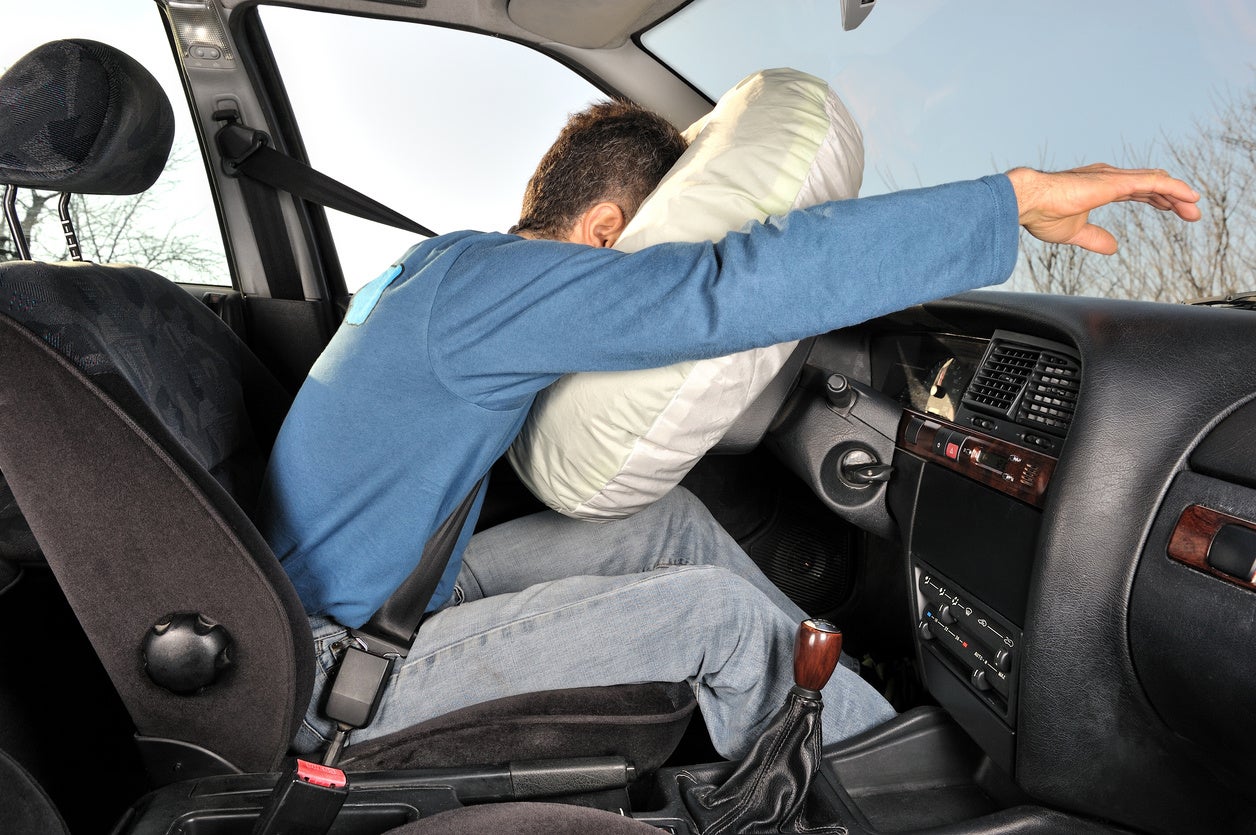
Airbags may cause severe injuries in case they are deployed with excessive force, or are deployed in crashes that are slow-speed or involve faulty components. Liability may lie with the car manufacturing companies, airbag manufacturers,, or careless driving, rs depending on the situation in question. It is important to understand the origin of the problem to establish who is liable with regard to finance and legal responsibility.
Frontal occupants airbags have been mandatory in all U.S. passenger vehicles since the close of 1990 and have already saved more than 50,000 lives, which have been saved thus far. They can be implemented in less than one-twentieth of a second with a massive impact that might harm passengers closely near their vehicle who are not belted or not even belted correctly. Even though they are designed to save lives, airbag injuries are a known risk and specifically, a risk during system defects and low-speed crashes, and where the individuals involved are small adults or children.
Being aware of the reasons for such injuries and identifying the party that ought to bear the responsibility helps victims to seek the legal recourse that is relevant. The reasons, the parties that may be responsible, and at-risk groups are the key points of information that will be given in the following sections.
What are the most Frequent Causes of Airbag Injuries?
Deployment force and velocity are the major causes of airbag-related injuries. Airbags inflate within milliseconds, and the occupants sitting in a place too close to the dashboard or steering wheel may be burned, fractured, or even bluntly hit. Unbelted people are at a high risk of injury since they tend to be thrown forward when the airbag begins to deploy.
Another major cause of injury is the failure of airbag components. In the Takata recall, the largest in U.S. car history, which involved approximately 67 million vehicles, and which has been linked to at least 23 deaths that have been confirmed in the United States. Defective inflators that may stop releasing suddenly may make the safety feature one of the biggest sources of danger.
Who is most likely to Suffer as a victim of an Airbag?
The infants, children, and rear-facing infants are more prone to injuries, as well as shorter adults who are close to the steering wheel. Children under 13 should never be seated in the immediate area of an operating airbag or should be seen in a rear-facing child seat.
Older individuals with smaller frames are at greater risk since the force applied during the deployment is not corrected to adhere to physical variations. Sitting in a slanting or reclining posture and having arms in a very close position to the airbag module are the factors that enhance the risk of an impact on the body.
Product Liability and Defects by the Manufacturer
In a case where a person is injured by an airbag due to a defect in design or a manufacturing fault in the manufacture of the inflator, the manufacturer or the manufacturer might be liable under the product liability law. The faulty systems remain dangerous even after the rapid development of the sphere of airbag technology.
The manufacturer of the vehicle or the supplier of airbag components, or the bot,h can be sued by the victim. Most of these cases have focused on proving that it was unreasonably hazardous in the first place and that the defect was the direct cause of the injury.
Should a Driver or any Other Party be held Responsible?
Most injuries caused by airbags take the shape of faulty airbags. The negligent driver who caused the accident may have sole responsibility for injuries as a result of the impact, and also for injuries that are due to the use of airbags. In case of careless or reckless action that resulted in a collision, the driver is responsible.
The repair shops that fail to fit airbags correctly and attach them improperly or offer fake parts may be held liable as well. The use of non-standard inflators that are not to the standard has been recognized by NHTSA to be an increasing safety issue, and several deaths have been attributed to faulty replacement parts.
What to Do after an Airbag Injury
The injured individual should also seek immediate treatment, no matter how trivial they might seem, due to the airbag. To maintain evidence of the vehicle, acquiring an accident report and documenting all the medical treatment is what leads to an act in court. By calling a personal injury lawyer who has dealt with product liability, victims will have a clue of what they can do and demand the rightful settlement.
Final Thoughts
Airbag injuries can be caused by the defect in the manufacturing process, inappropriate usage, or as a result of the negligence of a driver. This typically involves more than one individual. The most important initial steps to compensation would be to identify the cause of the issue and the culprits. Everyone who has been hurt should take immediate action to protect the rights of their justifiable representatives and receive the settlement he deserves.
Key Takeaways
- Airbag injuries are normally due to a sudden force of deployment, improper seat position, or faulty parts, such as faulty inflators.
- Faulty airbags, such as thos, wthathave been recalled on a massive scale, such as Takata, can result in serious injuries and may be the source of a product liability lawsuit against the manufacturer or supplier.
- Smaller adults, children who are not belted, and those who are not positioned properly are at risk of getting more injured in case there is an airbag deployment.
- The airbag liability might go beyond the manufacturer to include those who do the repairs on the car, incompetent drivers, repair shops, and dealers of faulty spare parts.
- Seeking medical care immediately and being able to preserve the evidence and seek the advice of an expert attorney are key factors in confirming your right and seeking the right to compensation.